
NEW MOMENTUM
Working Together, World's Apart
By Josh Lieto, BA Anthropology & Spanish, 2012
By Daniel Zaharia, BA Economics, 2012
The United States Central Intelligence Agency lists Nicaragua, a small Central American country about the size of Ohio, as the western hemisphere’s second most impoverished nation...
By Josh Lieto, BA Anthropology & Spanish, 2012
By Daniel Zaharia, BA Economics, 2012
The United States Central Intelligence Agency lists Nicaragua, a small Central American country about the size of Ohio, as the western hemisphere’s second most impoverished nation. Despite—or perhaps because of this—nonprofit organization Esperanza en Acción decided to set up shop there.
Meaning “Hope through Action” in Spanish, Esperanza was founded over a decade ago with the intention of empowering people around the world through the practice of fair trade. Custom-fitting the principles of the well-known Fair Trade Federation to its own mission, the company is committed to ensuring that its clients in the third world are paid a fair price for their work and that they can, with that fair wage, cover basic needs such as food, shelter, healthcare, and education for their families.

Plates and bowls are a popular export. Here, a sculptor smoothes the clay on a pottery wheel—the first step of many.
Many of these clients are artisans, people who weave textiles or make pottery. Esperanza buys directly from these artisans, whose crafts are then placed in fair trade shops internationally, such as Kirabo, a fair trade store in East Lansing. In this way, the company provides their clients with access to international markets in addition to the fair price Esperanza paid up front for the merchandise.
Among other things, this way of doing business respects these artisans’ cultures and traditional lifestyles, allowing them to carve their own path out of poverty. It also leaves room for Esperanza’s workers to create long-lasting relationships with the people they help.
Taken together, all of these practices mesh well with Spartan Global’s mission of alleviating poverty through microfinance—a method in which entrepreneurs in the third world or other people in need are given small loans to grow their businesses, smooth their incomes or otherwise better their lives. Recognizing this, and in search of a fresh organizational partnership, former Spartan Global president Dan Zaharia and former vice-president Josh Lieto contacted Esperanza en Acción to inquire about a potential partnership.
Esperanza’s response was more than enthusiastic. From October 2011 to November 2013, 8 of Esperanza’s artisans have received microloans. What’s more, the loan contract stipulated that these loans would form a revolving door of credit—that is, once the loans were paid back, the money would stay in Nicaragua and be lent out over and over again. In addition to the capital that they receive from Spartan Global, artisans get solid business consulting and advice in risk management from Esperanza en Acción—in effect, the alliance between Spartan Global and Esperanza provides them with “the best of both worlds.” In turn, the partnership and resulting loan contract, pioneered by Zaharia and Lieto, was the first of its kind in the organization and became a major component of Spartan Global’s field presence.

Esperanza artisan hand-sculpts small clay llamas. With the help of Esperanza, these handcrafts are exported to fair trade shops throughout North America.
In fact, this loaning venture has been so successful that Spartan Global members began planning a research trip to Nicaragua. In September 2012, the Associated Students of Michigan State University offered Spartan Global a grant to defray the expenses of traveling in January 2013. Unfortunately, logistical problems prevented travel during that time, but Spartan Global was happy to have the support of ASMSU and looks forward to the possibility of collaboration with the Association in the future.
In turn, Spartan Global’s plans for its future research trip to visit field partners are broad in scope and ambitious in design. In addition to touring organizations' in-country facilities, members will meet and interact with entrepreneurs and artisans who have received microloans from Spartan Global. Participants in the trip will also gain practical research experience, collecting survey data using a question template developed by Spartan Global’s executive board members.
Currently under revision, this template is modeled on Grameen Bank’s insightful Progress out of Poverty Index (PPI). Principally, this Index takes into account ten non-financial indicators, such as access to drinking water, type of housing, and the number of children attending school. This index also takes into account factors relative to each community and culture, such as traditional family size. Basing its survey questions on indicators from Grameen’s PPI index, Spartan Global will custom-fit its survey for the country of Nicaragua.
In conclusion, the past few years have been both an exciting and informative time for Spartan Global and its members. We have successfully reached out and formed a lasting connection with Esperanza en Acción, extending lines of credit to hardworking entrepreneurs in Central America and expanding our group’s international reach. Looking forward, we hope for the possibility of more fruitful partnerships and the ability to provide people around the world with the opportunity to better their families, their communities, and themselves.
Why Microfinance Matters
By Joan Campau, BA James Madison College of Public Affairs, 2012
As Americans, we don’t often consider our own ability to access credit: with the exception of business owners and financiers....
By Joan Campau, BA James Madison College of Public Affairs, 2012
As Americans, we don’t often consider our own ability to access credit: with the exception of business owners and financiers, many of us think about getting a loan only when we are making a large personal investment, such as a house or a college education. Thus, it is relatively easy to take for granted the ability to borrow money.
In the developing world, however, the transition from a subsistence (and highly impoverished) lifestyle to lucrative employment is often severely limited by unequal or nonexistent access to credit. In such cases, traditional lending institutions, like banks, are unlikely to loan money to individuals with few valuables to use as collateral. Private companies often charge exorbitant interest rates, and friends and family of the would- be borrower often have very little money to loan.
In situations like these microfinance can be a powerful tool for social and economic transformation, as it provides fair, transparent, and low- or no-interest loans to entrepreneurs. A case study from Nicaragua demonstrates the need for intelligent, proactive microfinance and helps to shed light on some of the difficulties faced by individuals without access to this kind of credit.

A women sells dry goods and other food and pharmaceutical items out of her small store in the town of Pearl Lagoon. She is hoping to purchase a refrigerator soon in order to serve chilled beverages.
The Caribbean Coast of Nicaragua is divided into two autonomous regions, the Región Autónoma Atlántica del Sur (RAAS) and the Región Autónoma Atlántica del Norte (RAAN), which are geographically, politically and ethnically distanced from the Pacific side of the country. Similar to the tumultuous national legacy of contested political power, legal jurisdiction over the Coast has only recently reached a relatively stable situation. Significant conflict between Atlantic and Pacific leadership, as well as feelings of disempowerment and mistrust among the Costeños (RAAS and RAAN residents), led to the adoption of the Autonomy Statute in 1987, which recognizes and clarifies the rights of the coastal people to communal land, local governance and educational opportunities in their own languages.
There is not, however, a single culture or language that is representative of the Coast; just as Costeños differentiate themselves from their Pacific countrymen, so too do people differentiate between various ethnic groups and geographic regions within the Coast. In addition to white and mestizo citizens, the Coast is also comprised of five main ethnic groups: the Miskito, Sumu, Rama, Creole and Garifuna. The Spanish, English, Creole, Miskito and Sumu languages are all spoken to varying degrees, and each ethnic group celebrates a unique cultural history.
Though they account for nearly 50 percent of the landmass of the country and much of the natural resource base, the RAAS and the RAAN only hold about 10 percent of the total population. Many of these people feel exploited by both foreign interests and historical national policies, and have successfully lobbied for an official demarcation process that will clarify their rights to land and resources.
These past and present tensions significantly inform the manner in which Costeños conduct their business. In the 1970s, Bernard Nietschmann documented the beginnings of a shift from a reciprocal exchange system to a money-based economy among the Miskito peoples of the Coast. In the 40 years following his research, this trend has continued and many, if not most, of the exchanges among all of the peoples of the Coast involve some sort of monetary transaction. This is especially true of goods that have been imported: shop owners must pay their Pacific suppliers in currency, and are thus obligated to charge their customers money, rather than the ability to return a favor.
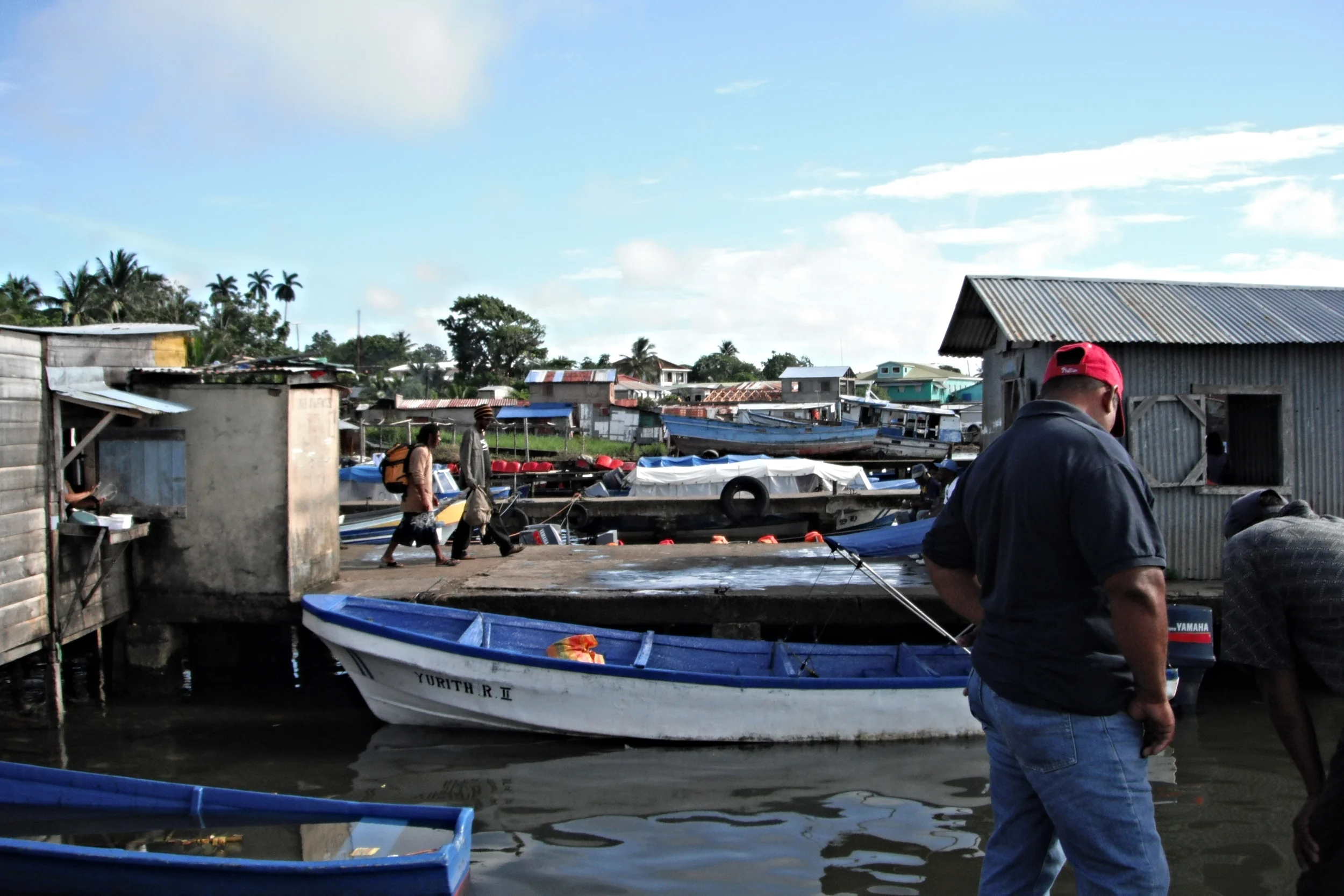
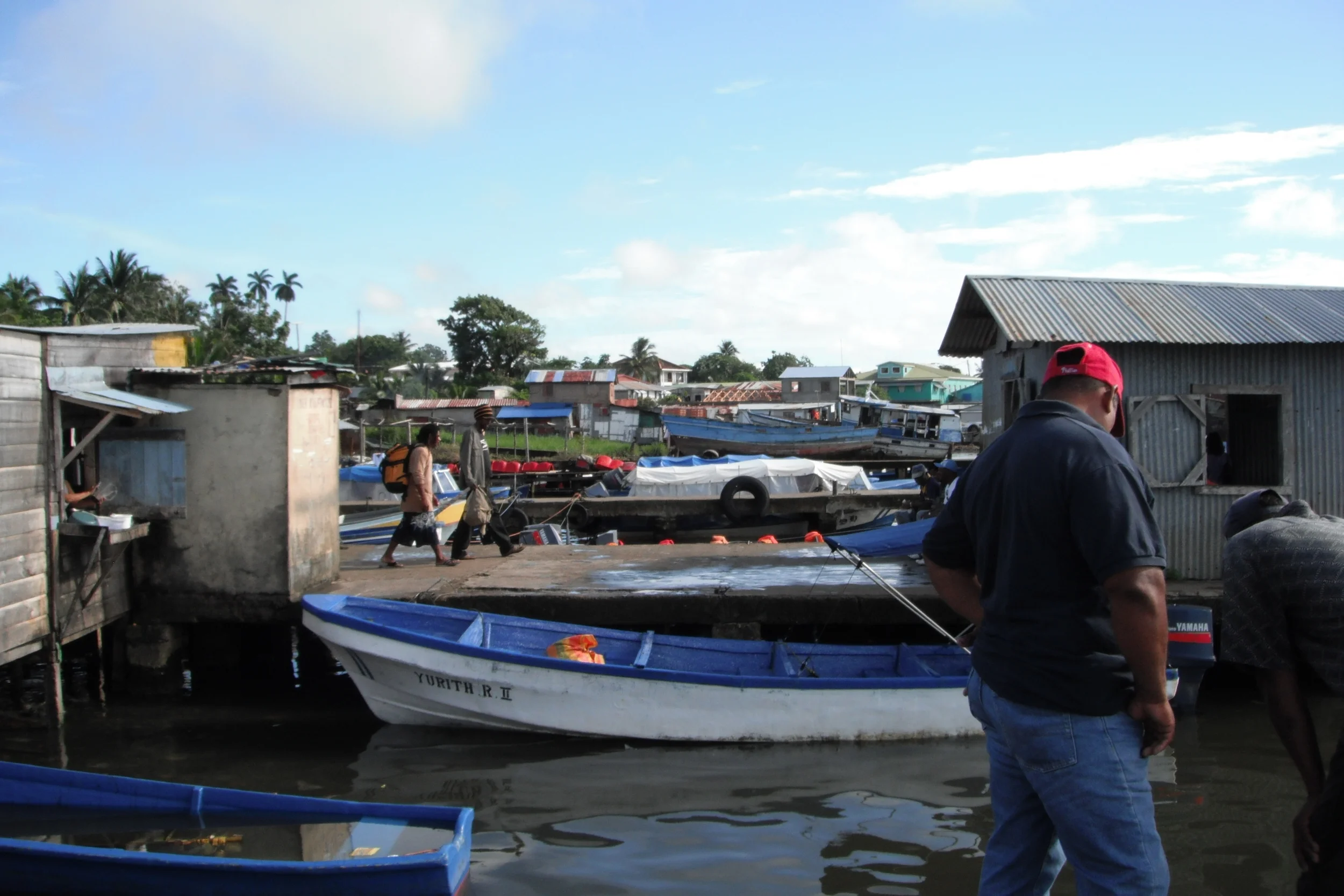
The wharf at Bluefields, regional capital of the RAAS, bustles as Costeno fishermen bring in their catch for sale.
During my research on the use of inter-firm credit among small shop owners in communities around the coast, I interviewed about 50 shopkeepers from seven communities. From behind the counters of their one-room variety stores, they told me about the transition from substance farming and fishing to this new occupation as small business owners and their difficulties getting started. In general, their narratives went like this:
Joe farms a plot of communally owned land and fishes in the Pearl Lagoon during the rainy season to provide food for his family. He notices that with a new road from his small community to Managua, Pacific vendors have increased access to the fish, sugar cane and vegetables of the Atlantic Coast. With increased frequency (but still sporadically), Spanish-speaking men drive trucks filled with new clothes, ropes, buckets, tools, small candies and soda from Managua down the road into his village, where they sell these items to Joe’s neighbors. In return, the truck drivers purchase and transport the Costeños’ surplus fish and agricultural products for sale in the big city.
Joe sees a business opportunity here: his neighbors have expressed the desire to purchase the processed foods and imported housewares more regularly, but they aren’t able to because the trucks only come once a week. So Joe decides that he will fill this niche: he will set up a small shop where his neighbors can purchase the things that they want any day of the week. Joe is realistic. He knows that he will still have to farm and fish to fully support his family, so the store will have to be small—just one room—and probably adjoining the house so that his wife and children can tend it while he is planting the cassava and hauling in the nets.
And here’s where Joe’s problem begins. While the wood and other natural resources necessary to actually build the shop are readily available on the communal land, he doesn’t have the money to stock the store. So Joe travels for many days to arrive at the regional capital in search of a bank. When he gets there, however, his loan application is denied because the rights to the land that he farms and the Lagoon where he fishes are communally owned, meaning that Joe doesn’t have any collateral to stake.
Undaunted, Joe instead goes to Gallo, an appliance store where he hopes to purchase a refrigerator for his sodas. He asks if he can purchase the small fridge on credit, and is promptly shown into the manager’s office. The manager brings out a multi-page document written in a language foreign to Joe, and tells him to print his name on the line so he will be able to take the appliance home with him that day. Intending to pay back the loan as soon as he can, Joe signs his name, and soon after installs the first piece of equipment in his new store. Still in need of items to stock the shelves and new fridge, he goes to a wholesaler and asks the man there to advance him some of the products he thinks will be most likely to sell in his community. Again a bargain is struck, and within a week Joe has officially opened his shop.
Within two weeks, however, a stranger has come into the village and is asking around for Joe. His neighbors give directions to Joe’s house, and the stranger knocks on the door. Following the traditional coastal greetings, the stranger informs Joe that he’s there to collect the first payment on the refrigerator. Joe is confused because this isn’t the man he had spoken with at the appliance store, and he’s sure that there must be some misunderstanding. Joe informs the stranger that the store just opened two weeks ago and has been doing only small but steady business: he doesn’t yet have the 500 córdoba (about $25) the man seems to expect. The man makes a mark in his book and leaves, promising to be back in two weeks.
Over the next few days, business picks up and Joe sells out of his inventory. Excited because he’s almost collected the 500 córdoba for his first refrigerator payment, he returns to the wholesaler for more supplies. The wholesaler tells Joe that he will only be allowed one more round of goods on credit, and then he will have to pay up front. Sure that he can make enough profit with this inventory to pay for both the first installment on the refrigerator and the next set of items, Joe gratefully agrees to these terms and returns home with the supplies.
Over the next week business continues to grow, and by the time the stranger has returned for the refrigerator payment, Joe has scraped together 750 córdoba: enough to pay the first installment on the refrigerator and to repay the wholesaler. When the stranger comes to the door this time, though, he informs Joe that he now owes 1000 córdoba. Protesting that the second installment isn’t due until next month, Joe asks the refrigerator company representative why the amount has doubled. “Interest” is the man’s one word reply as he makes another mark in his book, takes the 500 córdoba Joe is able to give him, and leaves. Over the next couple of months, this pattern continues, and finally the wholesaler refuses to give Joe any more supplies on credit, and the refrigerator company comes to reclaim their appliance. Although he borrows small amounts of money from his extended family members and even asks his neighbors for help on the payments, Joe can’t keep up with the huge interest rates and ultimately has to close the store.
Of the fifty people I interviewed that summer, not a single one had obtained credit from a banking institution. As a Garifuna and of Afro-Caribbean descent, (or a Miskito, Sumu, or Rama and of indigenous descent), the shop owners are considered minorities in this predominantly mestizo Spanish-speaking country, and many reported significant racial and ethnic discrimination. Moreover, the communal ownership of the land they farmed (as decreed by the Autonomy Statute of 1987) gave them very little personal collateral to stake.

The smallest stores are set up in living rooms and on porches, often selling produce directly from the shop owner's farm.
Instead, they often relied on loans from private companies—like the appliance store that sold Joe his refrigerator. Without fail, the small shop owners reported that the interest rates charged on these purchases made it impossible to keep up with the payments. The contracts they had signed in the managers’ offices were often in a language unfamiliar to the Costeños, who had difficulty reading even in their native languages.
Several business owners suggested that instead of these traditional lending institutions, they instead relied on financial assistance from their friends and family to get the shops started; however, it was still difficult to pull funds together from people who still generally participated in a reciprocal exchange system rather than a market with currency. Some people who had children or cousins working on American cruise ships saved up the remittances sent home to them, but the seasonal and uncertain nature of that work again made it difficult to collect enough money to get started.
Microfinance matters because people in the developing world often don’t have any other access to fair and reliable credit. When entrepreneurs are unable to use traditional lending institutions, microfinance loans provide a critical leg up to get them started in fledgling economies. Sometimes racial and ethnic discrimination makes a bank loan impossible, while other times legal structures or poverty mean that borrowers don’t have collateral to stake. In other instances, credit is offered by their suppliers or other vendors, but at exorbitant interest rates (made legal by contracts that are difficult to understand). Microfinance offers low or no-interest loans that often require only the promise of repayment.
And this faith in people is well rewarded: with extraordinarily low default rates and huge multiplier effects, microfinance has the potential to transform entire communities. In the United States, we don’t often think about the need for access to capital: it is easier to comprehend an immediate need for food and clean water rather than the underlying issue of self-reliance and economically viable communities. But in the developing world, the true transition out of poverty requires the establishment of local enterprises which are self-sustaining, rather than a continued dependence on charity. It is here that microfinance has an important role to play: instead of a hand-out, it offers a hand-up to entrepreneurs around the world. When those of us in the developed world participate in these loans, we offer our fellow human beings the chance to determine their own futures with dignity—and in doing so, we are advancing humanity by funding opportunity.